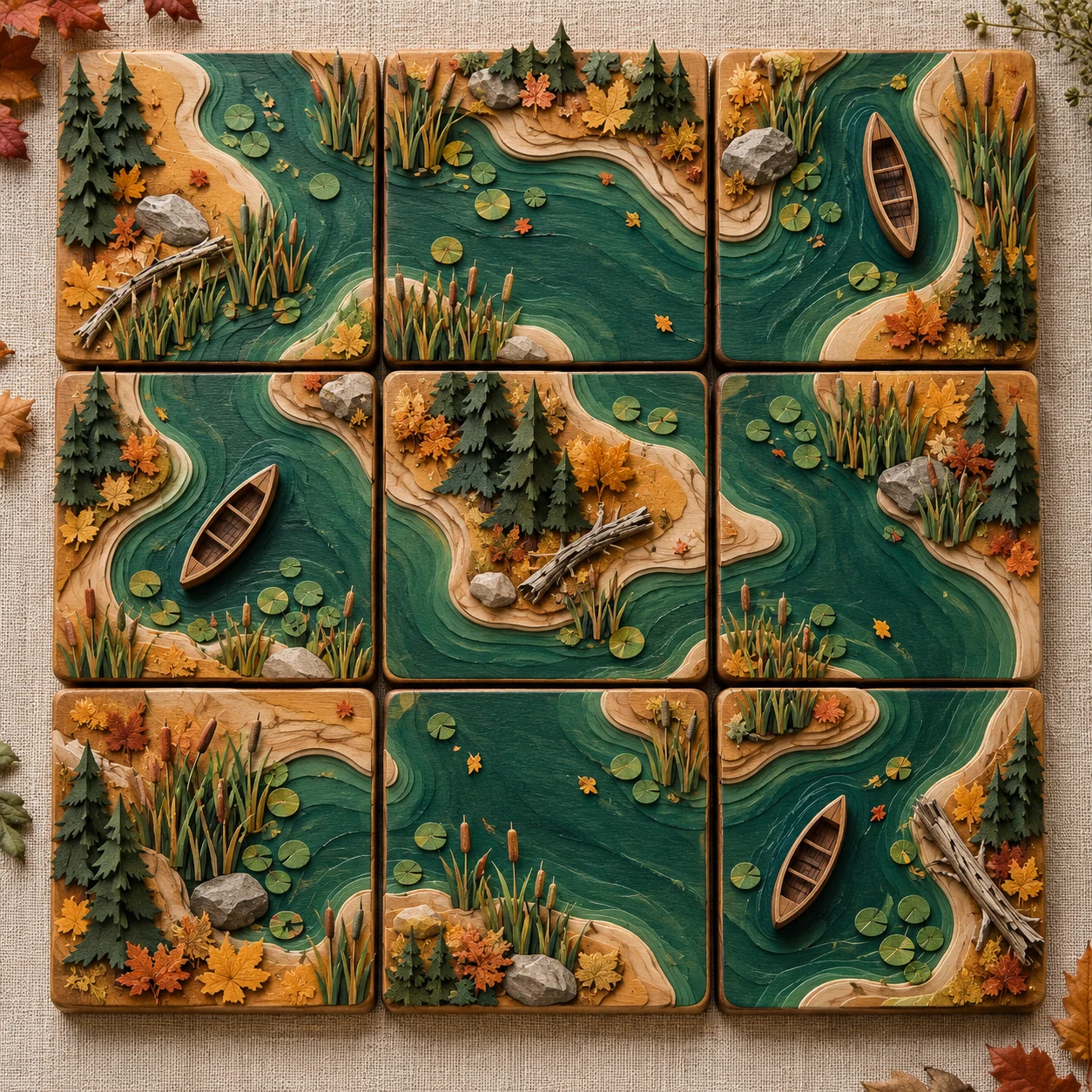
Choose one piece
Take a tile from the public row and refill that slot from the supply. You may place the new tile or exchange it with the tile in your reserve.
Make a connection
Place the chosen tile in an empty tray space. After the first placement, it must touch an existing tile along an edge. Rotation changes the illustration, not the habitat type.
Mark a growing pool
The first time you form a connected group of three tiles of one habitat, place that habitat’s bass marker beside your tray. Each habitat can earn its marker only once.
Read the finished lake
After everyone has placed nine tiles, count one point for every matching shared edge and three points per earned bass marker. Unplaced reserve tiles have no value.
Making the scatter set
A reed tile grants a reed symbol, a pool tile a stone symbol and a stream tile a pine symbol. Exchange one of each for a camp token. Spend a camp token to choose a tile of any habitat from the supply instead of the public row; it still uses your normal placement.
What decides the result?
Add matching-edge points and habitat bass markers after the ninth placement. The largest total wins. If totals are equal, compare the largest connected habitat group; if that is tied too, the lakes share first place.
After the first session
Begin with terrain, matching edges and bass markers. The illustrated guide and tackle cards are optional one-use aids: give each builder one at setup. To add weather, apply a Pine-Rain Shift after everyone’s third and sixth placement. All players still receive exactly nine placements.
Timber & Tackle is a woodland tabletop concept with a Big Bass Bonanza fishing influence. Each player builds a nine-tile lake. There is no movement die: the choices live in habitat connections, a small reserve of tiles and the patient art of leaving a useful space open.
See the illustrated card guide